Installation & Live Performance
Beginning in 2022 with 'Where Have You Slept?', socially engaged and conscious installation has been at the heart of my fine art practise. Combining everyday objects with painful truths and performative aspects, audience members are invited into a familiar yet terrifying world.
In 2025 I was awarded an Arts Council DYCP Grant to further explore my 'Hostile Interior Design' project and in 2026, I took part in my most high profile exhibition to date at Museum of Homelessness.
On the complete opposite side of this is 'Making Sense', a creative and messy exploration of the senses and neurodiversity!
Making Sense
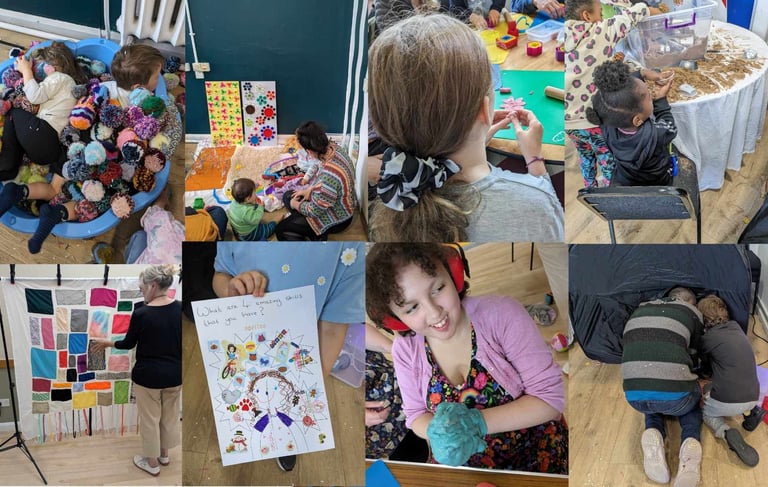
A fun, messy and engaging exploration of the senses and neurodiversity, this installation fits any room, any ages and any abilities. It currently features: a sandpit on wheels with hidden treasures, a paddling pool full of pompoms, mindful drawing and colouring, scented playdoh, slime customising, a fabric textures wall, a dark tent full of different lights and projections, spinny walls and a cozy carpet and blanket space. Coming soon are: fidget board, worldwide musical instruments, water beads play, shape and colour sorting, wooden car races and a floor maze.
Making Sense has featured at festivals and community groups and we'd love to come to your event and make a mess too (we promise to tidy up afterwards)!
Making Sense at Z Arts Haphazard Festival 2023. Video Credit: Catherine Shaw.
Where Have You Slept?
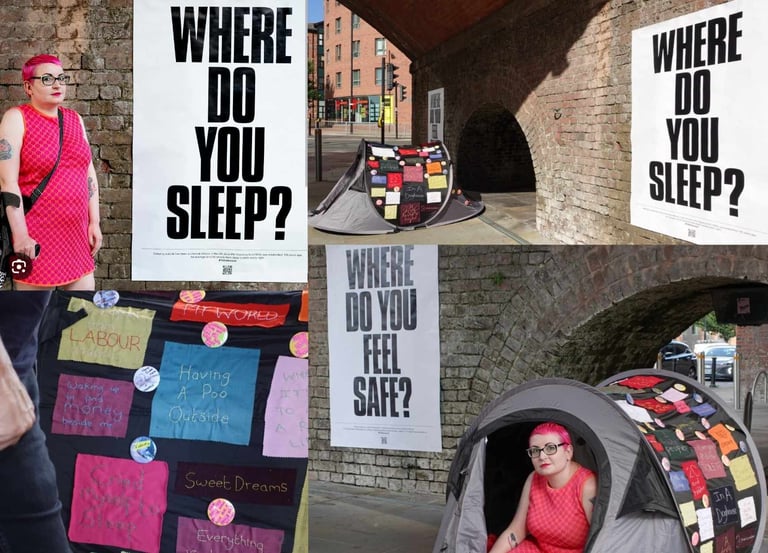
Created as part of British Art Show 9's Art Agents programme with HOME gallery in 2023, I worked with homelessness experienced participants from Our Room Manchester and drew on my own experiences of homelessness to expose the injustice of the Vagrancy Act. I created the five fundamental questions of homelessness, Where do you sleep?, Do you feel safe at home?, Can you have a bath?, Can you use the toilet? And When did you last eat? with the knowledge of how difficult these questions can be to answer for some, whilst being easy to answer for others. I embroidered the participants' answers to these into the tent and invited members of the public to climb inside, sit on the hard ground with nothing but a thin sleeping bag under a railway bridge and feel the weight of the words above their heads, an act that would be illegal if they were actually homeless. I also worked with Office of Craig to create an accompanying poster campaign. The installation has since been exhibited in the Turnpike Gallery and has been taken to schools and galleries with an accompanying protest badges workshop for young people.
Photo Credit: Liza Mortimer, TT News.
Hostile Interior Design 24
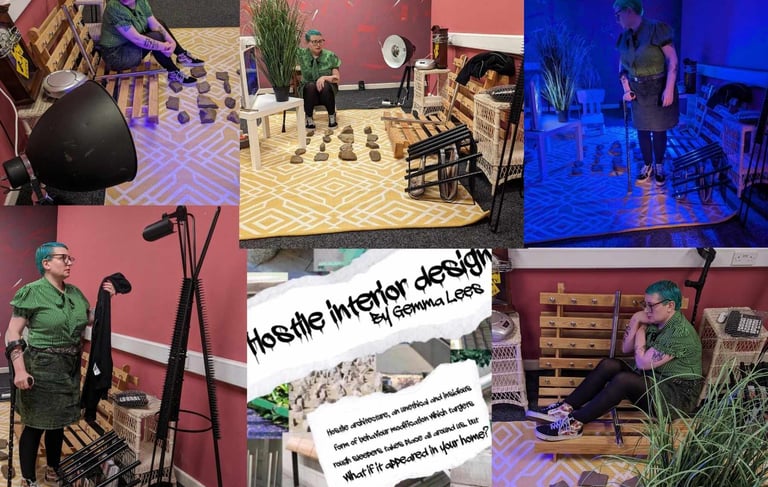
I created this combined installation and performance exposing hostile architecture whilst on the Arts and Homelessness International Associate Leadership programme with the support of Theatre Deli Sheffield. As both a physically disabled and homelessness experienced person I sought to raise awareness of the every day behaviour modification that takes place everywhere we go. The main behaviour that sloped seats, bars on benches, uneven flooring, blue lights, discordant noises and spikes are attempting to curb is bedding down of unhouse folks. Sleep is a human right and stopping someone from sleeping is literally torture. These things also make navigating the world very difficult for physically disabled people. During my one-week residency, we constructed the non-living room from once used and loved furniture and devised an excruciating performance in which the audience are forced to watch on as I tried to complete everyday tasks in an environment that was designed to hurt and restrict.
'Hostile Interior Design', Theatre Deli Sheffield, 2024.
Badge Of Dishonour
Working with London School of Economics and Political Science's archives and Arts and Homelessness International in 2025, I was given the opportunity to explore what’s missing in the archives for a working-class Romany Gypsy woman, the history of poor laws and protest and the uniforms and badges we all are made to wear from the moment we are born. How these are shaped by the media and how they lead to the hatred, racism, othering and misunderstanding that has plagued our society for centuries. I created GRT Pride badges, based on the designs and slogans of LSE archive's LGBTQ Pride badges from the late 70s and early 80s, reclaiming the black triangle worn on the uniforms of Roma and Sinti victims of Nazi concentration camps, inspired by the reclamation of the pink triangle. These were distributed to the closing event's visitors. I also created contemporary versions of the Elizabethan poor or beggar's badge, which I read about in LSE archival texts, by badging work uniforms and clothing demonised in the press as being the uniforms of 'chavs', with the logos of Job Centre Plus, Universal Credit, Healthy Start and other forms of social security. The visitors were also encouraged to try these on to feel badged in a negative way. The sketch book that I created detailing my experience and finds in the archives, plus my final output and the speech I delivered at the closing event have been added to LSE's digital archives.
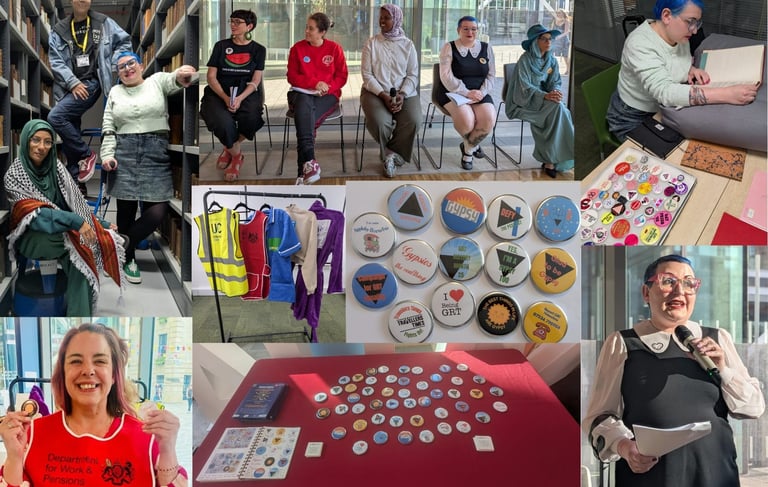
Badge of Dishonour 2
In the second iteration of this project, I wore three of the different costumes emblazoned with the logos of contemporary benefits, representative of 15th Century Beggar's Badges and how we are still today labelled invisibly as benefit claimants. I handed out logo badges to audience members with disgusting quotes from the internet on them and spoke about the project on a 1to1 basis. I also created a live painting with quotes from MPs with those same internet comments, showing a literal trickling/ bleeding down of attitudes about folks on benefits and the poor.
Badge of Dishonour at Social Experiment, Contact Theatre, 2025.


She's In Pieces
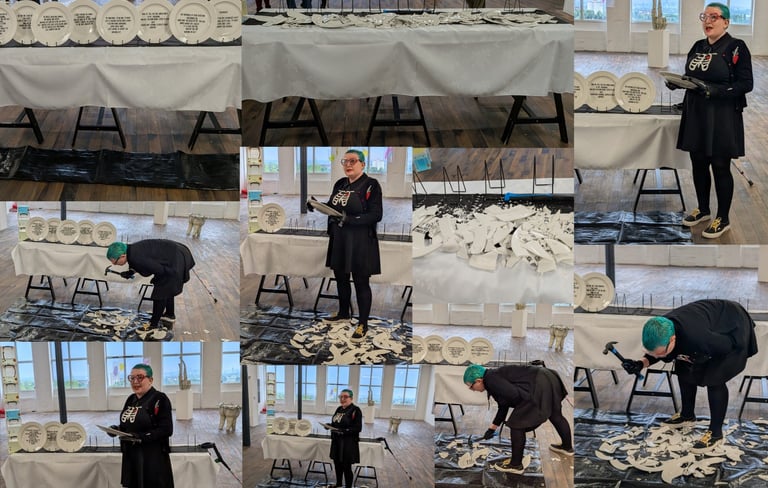
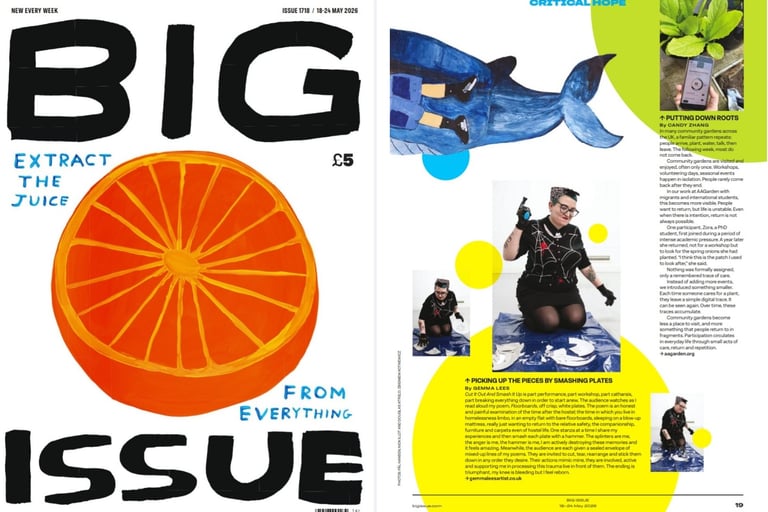
The piece, which begins as a line of plates each decorated with neat vinyl letters, a stanza of a poem a piece, in plate stands, on top of a crisp tablecloth. The poem tells my story of homelessness, of existing on the periphery, of having no home, nothing to answer when people meet you and ask ‘what do you do?’, because you’re in limbo and you do nothing when you’re trapped on the outside, waiting to be invited in. Then once you’re housed you realise that you’ve just reached a secondary periphery, you still do ‘nothing’ and now you sleep on an air mattress on an uncarpeted floor alone and afraid. I read each stanza to the audience before smashing each plate with a hammer. When I’m finished, I stand, in catharsis, sorrow and elation, in the broken pieces. The pieces along with the hammer were then displayed until the end of the exhibition. It is threefold, transformational, the silent suffering, the uncomfortable outburst that society would prefer peripheral people keep to themselves and the triumph over circumstance. It is not me that is now in pieces, it is the fear, anger, uncertainty and pain I have endured.
She's In Pieces, 1853 Galleries, 2026.
Cold Comfort/ Kushti Shillow
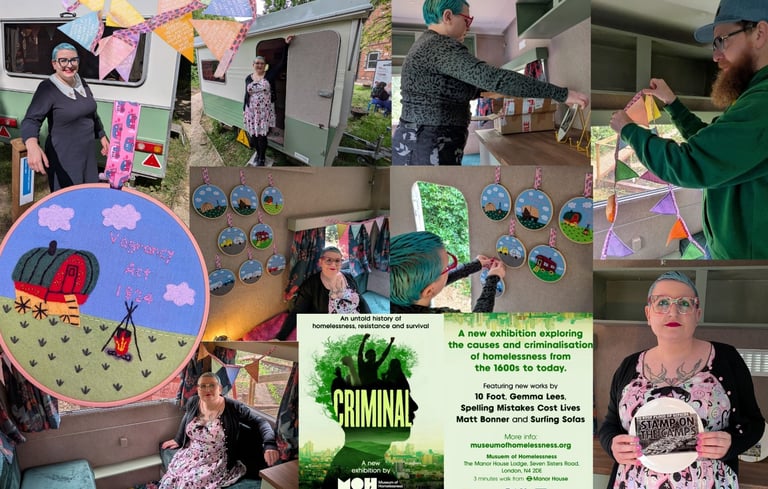
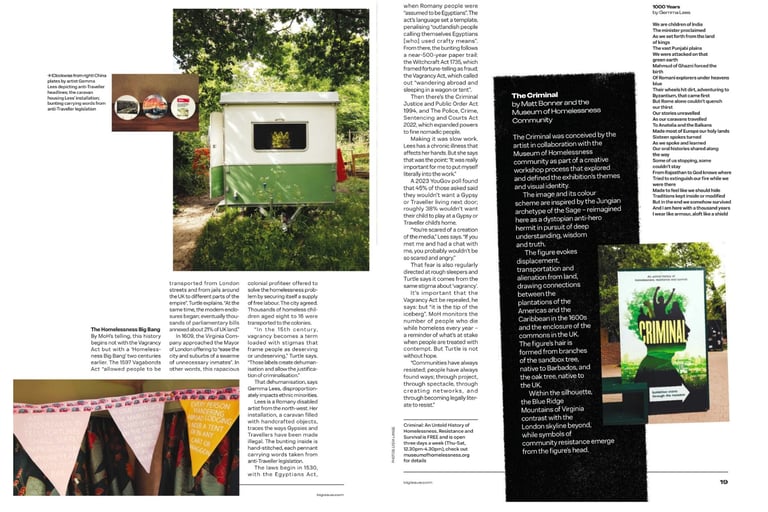
I was a part of The Museum of Homelessness's latest exhibition: 'Criminal: An Untold Story of Homelessness, Resistance and Survival.’ which mapped 400 years of criminalisation of homelessness and nomadic lives, with 10 Foot, Matt Bonner, Spelling Mistakes Cost Lives, and Surfing Sofas. Having experienced homelessness in my twenties and growing up in a large Romany Gypsy family, I have seen firsthand how the law dictates Travelling people’s lives and penalises folks for having nowhere to stop, often due to a critical shortage of transit sites. Cold Comfort/ Kushti Shillow, (Cold Comfort/ Comfort Cold), examines a society that objectifies and commodifies, yet systematically chips away at our freedoms and represents us as criminals in the mass media. Inside a beautiful little fold-up caravan, I celebrate the everyday rebellion of Gypsies and Travellers that lies in a fierce preservation of traditional customs and crafts. On one wall, eight embroidery hoops depict different laws that have targeted us, from the Egyptians Act in the 1530s to 2022’s Police, Crime, Sentencing and Courts Act. Quotes from each of these are depicted on pastel bunting, othering language such as, ‘Every idle or disorderly person’ and ‘Gipsies and other persons of nomadic habit’. The text is white and difficult to see until you look closely, as is the nature of anti-Gypsiysm and hatred against Travellers. The proggy rug delves into this further. On the surface it’s beautiful, but look closely and you will see rags that say, ‘I’m not being funny but’ and ‘I’m not racist but’, the beginnings of sentences that we dread hearing from people we’ve come to like. China plates are printed with The Sun’s 2005 ‘Stamp On The Camps’ campaign and a similarly prejudiced headline from April this year, along with an iconic scene from the 2011 Dale Farm eviction, an action that left scores of families displaced. More Sun headlines are printed onto three cushions that spell out, ‘Home/ Sweet/ Home’, the letters corrupted with the newspaper’s criminalistic language of invasion, words such as, ‘military operation’, ‘illegal’, ‘chaos’, lang grab’, ‘bulldozers’, and the rather bizarre, ‘want to buy my dog for £250’. The piece was positively reviewed in 'The Guardian', 'Big Issue' and 'World Of Interiors who also featured an interview with me in a social media reel.
Reel credit: World of Interiors, 2026.
'Big Issue' 15th-21st June, 2026.
Cut It Out & Smash It Up
This performance fuses cut-up poetry, live art, audience participation, exorcising the ghosts of a painful past, extreme catharsis and smashing plates with a hammer. Its first version was created for the Arts and Homelessness International showcase at the end of my Associate Leadership Programme in 2024, with the audience making cut-up poems from mystery envelopes of lines of my various poems about homelessness whilst I read lines aloud from plates and smashed them with a hammer. In 2026, 'Big Issue’ featured Arts and Homelessness International and images of this performance with my words written this year.
AHI Showcase, 2024.
Hostile Interior Design 26
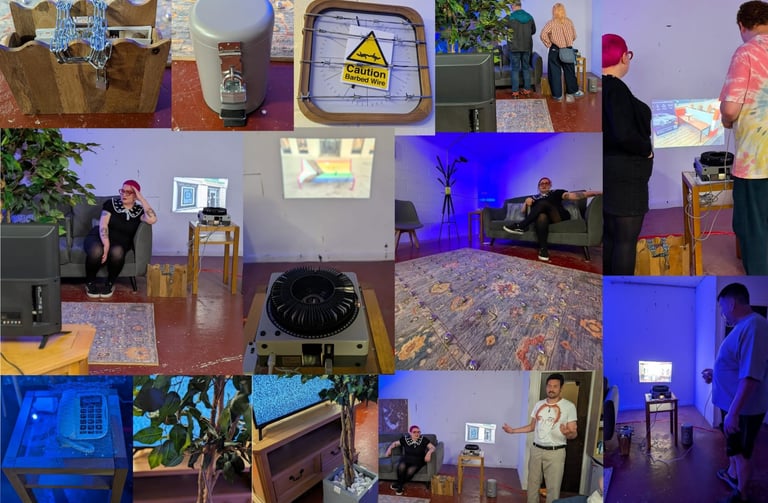
In 2024, I was awarded an Arts Council DYCP grant to further explore my Hostile Interior Design project and the Non-Living Room. As part of this research project and R&D, I traveled to 7 UK cities to document examples of hostile architecture. 80 of these images were made into slides to be played on a slide projector reminiscent of the one that my Grandma used to make us watch endless holiday snaps on. I also worked with Tommy Dyson and Ushiku Crisafuli to create a soundscape to underscore the piece inspired by hostile architecture, dispersal noises and the sounds of the city. The Non-Living Room furniture was upgrade with the support of a fabricator to create: a sofa with a metal bar in the middle, a lamp with a blue light bulb, a rug dotted with demarcation studs, an oversize plant in a planter with skate stoppers around it, a TV obscured by the plant playing only static on a stand plastered with 'No Entry' signs, a coat rack covered in bird spikes with a 'Caution Bird Spikes' sign and a CCTV camera with a blinking red light focused on the sofa, a chained and padlocked magazine rack full of interiors magazines, a waste paper bin with a rasp lock and padlock, a wall clock covered in barbed wire and a 'Cation Barbed Wire' sign, a chair leaning forward at an uncomfortable angle and a telephone encased in chicken wire. I installed the new Non-Living Room in Manchester Street Poem for a week in which people were able to visit, interact with the installation, chat about the issues raised and give feedback. The Non-Living Room is now ready to be entered into other gallery shows.
Tour of Non-Living Room, 2026.